SYNAOS
SYNAOS runs intralogistics in plants and warehouses: robots, forklifts and people in one system. My job is to turn a highly technical tool into an application those people can understand and trust.
Role: Senior Product Designer
Year: since 2023
One designer per product team
I joined SYNAOS at the end of 2022, a bit tired of the chaos at my previous startup, lively as it was. What sold me: SYNAOS had a design system and a few smart designers, and it was nothing like what I knew. Real tech. And freaking robots! Honestly, I didn’t expect to stay that long.
Back then every product team had its own designer. I was in Mobile Robots, in a discovery trio with Daniel, our product manager, and Christian, our engineering manager. We mapped what we learned in opportunity solution trees, and I turned it into concepts, tested them and stayed with the frontend developers until a feature shipped. I enjoyed it a lot: a high-tech environment, full of people who speak a different language. Code.
It never got routine. One screen can show vehicles from different makers, chargers, stations and transport orders that depend on each other, and the same app serves the engineer setting up a plant, the supervisor watching a shift and the person called when a vehicle stops. They’re experts, so “simple” doesn’t work. I aim for complete but self-explaining.
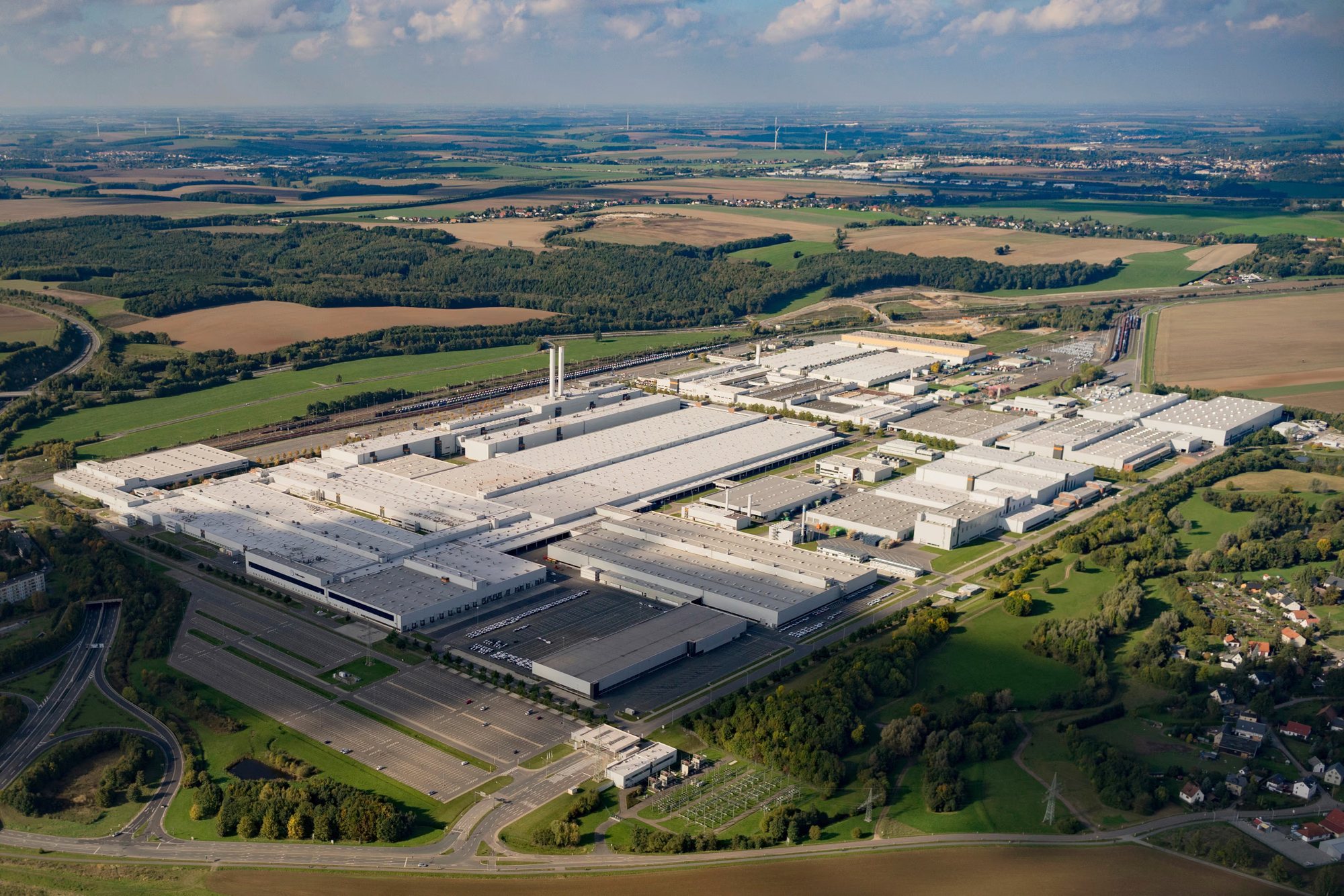
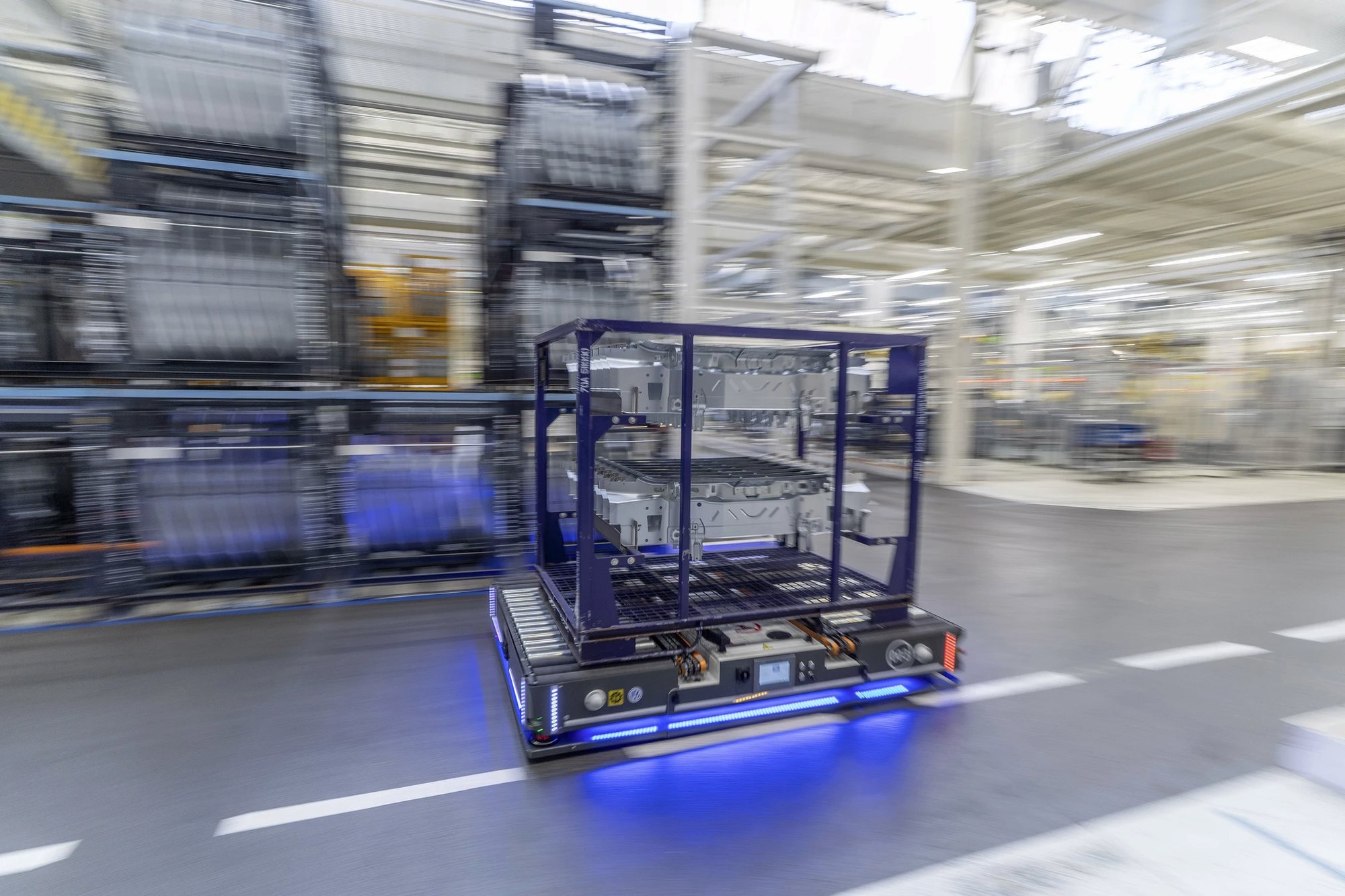
The scale of it: a car plant is a city of halls, and material has to reach every line on time. A mobile robot bringing parts to the line. SYNAOS tells it where to go, and when.
The only designer
Today I’m the only designer at SYNAOS. There’s more work than one person can do by hand, so a good part of my time goes into things that let others do it without me, or do some of it for me. The first were our six Design Principles: in March 2024 I facilitated a workshop where our design team wrote them down, with our head of product in the room to keep them in line with the strategy. They’re still in use, so design calls end up in the same place, whoever makes them. The rest came step by step: the design system, AI, research and data.
Design system meets AI
SYNAOS isn’t one app but a family of frontends built by different teams, and they didn’t look like they belonged together. Many still differ, but pushing for one library and design tokens paid off. Maciej Balasiński led the design tokens (his article about them). Every new component goes through me, but what really holds the apps together is advocating, over and over. Teams working close to customers need things fast, and building their own extension used to be the quick way. Now the library is usually rich enough to cover what they need, and teams tend to ask me first, because over time I’ve built that trust.
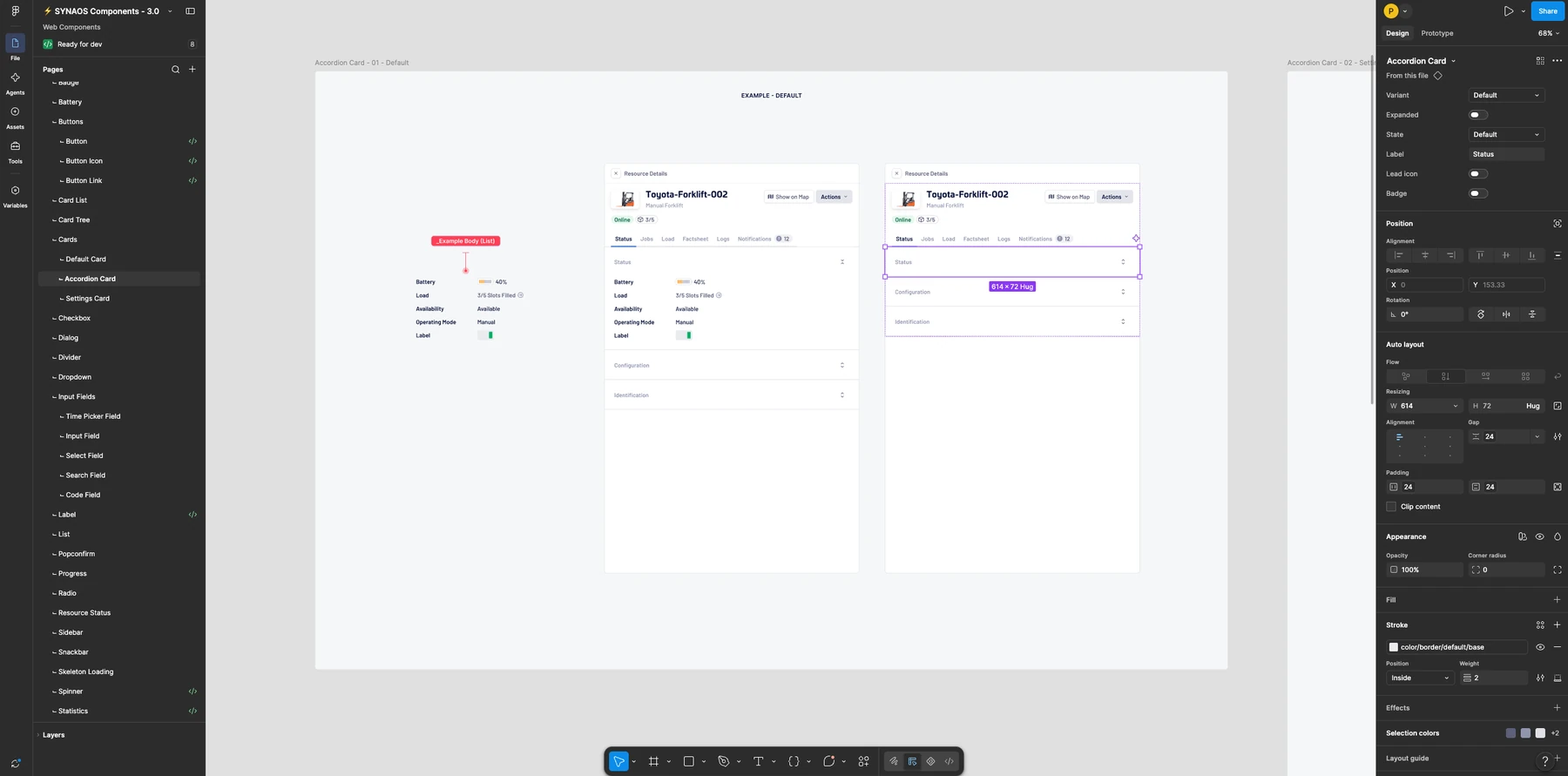
Left: the product icons I drew for SYNAOS, all on the same 24-pixel keyline grid. Right: one of my components, the accordion card, in our Figma library. The source of truth has since moved, but for a long time this file was where a lot of my design system work went.
For a long time it was slow, unglamorous work. Then AI arrived, and it turned out to be exactly what we needed. A prototype from an AI tool is only as good as what it’s built from: without a library it invents its own buttons and makes the consistency problem bigger. With one, it uses the real thing.
So I brought our design system into Claude as a one-to-one copy of the component library the developers use, and wrote a skill around it: /synaos-design. A PM, or I, describes a screen in plain words and gets a design built from real components, plus a check of what came from the library and what’s missing. Missing pieces aren’t invented on the spot; they go to the design and frontend community first.
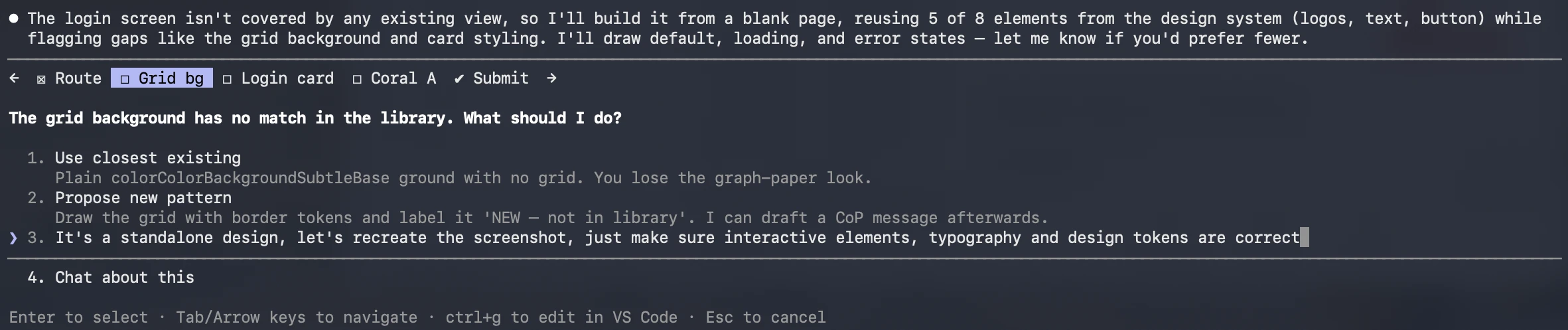
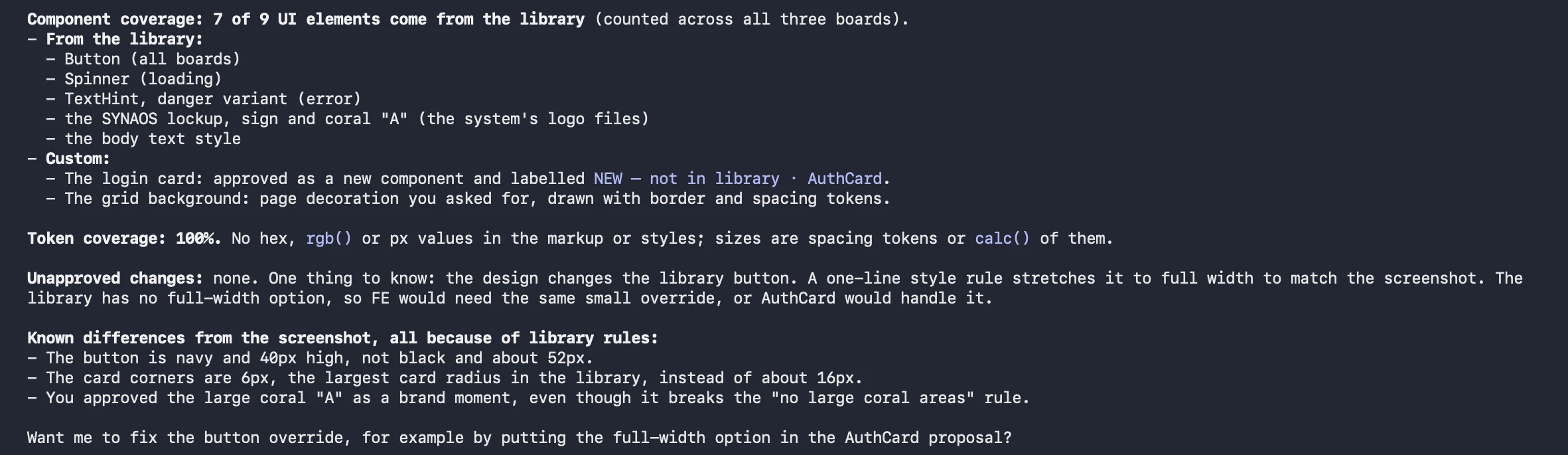
From my internal demo of /synaos-design: it asks before it invents anything and ends with a coverage check. And because the whole library is there, it works for fun too: Pac-Man on the shop floor, built from the same components.
AI is getting into the product, too. A hackathon project of ours grew into an AI assistant that lives on top of the shop floor. It isn’t released yet, but it’s close. At the hackathon we called it Pako, after our CPO’s dog, who was running around the office the whole time. The first version took the name seriously: whatever you asked, it answered “Woof-woof”.
The Pako icon from the hackathon, after our CPO’s dog. Next to it, that first version replayed for this page: ask about a vehicle, and it barks before it answers.
Research Operations
Customer knowledge at SYNAOS was everywhere: in Customer Success calls, Sales conversations, engineering tickets and chats. Everyone knew something, nobody saw all of it. None of us is a trained researcher, but I like Teresa Torres’s idea that the people who build a product should talk to its users, and do it regularly. So I started Research Operations with Daniel. Later Dennis joined, another PM, great at operations and at building agentic workflows.
We sat down with Customer Success, Sales and the other teams that hear from customers, and agreed on one way in: one email address, airfocus, or just a message to us. Every week an AI agent suggests which insight new feedback belongs to, or starts a new one, and insights backed by many sources get priority. Then Daniel, Dennis and I sit down together and check every connection, and whether each topic went to the right product manager, before it counts. Interviews run alongside, and we learned a few things the hard way: shop floor workers aren’t at desks, Customer Success has to be on board before we contact anyone, and without reminders people simply don’t show up.
Product analytics
Interviews tell you what people say. To see what they do, I pushed for product analytics for years. In Germany that’s a hard sell: tracking what people do in an app sounds like a GDPR problem long before it sounds useful, so it took a lot of convincing, with our CPO, our head of product and our lawyer. After about two years we got the green light, and Dima, our frontend lead, made it happen: he set up Umami, an open-source analytics tool built with privacy in mind, and builds the reports on top of it.
Now we’ve started using the data to enrich what users tell us. When an insight comes in from an interview or from Customer Success, I check it against how the app is really used, mostly by asking the data questions through Claude, connected over MCP, and share what I find with the product managers every week. Clicks still need context, so nothing goes straight into a decision: every signal gets checked by people who know the product, the same way we check insights.
It already changed my work. The data showed that far more people use the app on their phones than we expected: out in the halls, on the move. So I’ve started adapting it for small screens, one pattern at a time.
Selected work
Next to all the systems, I still design screens, and that part is as much fun as ever.
The dashboard: is everything running?
The dashboard is the first screen people see when they open SYNAOS. In 2024, together with Joline, the product manager for it, I ran a discovery to find out what it should actually do. We talked to engineers from our robot team, Customer Success, Sales and Marketing, management and customers, and tested an early concept with a team lead at one of the first customer sites.
The answers were all over the place. Engineers wanted to know how many vehicles are online and which transport orders are critical. Customers asked about the battery state of the whole fleet. One large customer mostly wanted raw data for their own analytics. It turned out we were looking at three dashboards in one: an operational one for running a shift, an analytical one for improving the process, and an executive one for the big picture. We started with the operational one.
It shipped in December 2024 as the highlight of a release: system health, fleet utilisation (at 100 %, it’s time for more vehicles), distance and time standing over the last 24 hours, vehicle status, and the five most urgent operations, all in one place. The analytical dashboard is being built now, and it starts from the same 2024 discovery. We checked it again, and it still holds.
Joline, the product manager I worked with, introduces the new dashboard (2024).
Better patterns
A big part of making the app explain itself is bringing in better patterns, and then using them everywhere. SYNAOS is a text-heavy app: statuses, IDs, parameters, logs. Without structure it’s a wall of words. The side panel is a good example of giving it one. Click a vehicle on the shop floor, a row in a table or almost anything else, and a side panel opens next to it, as an extension of the main view, not a pop-up. For an app this data-heavy, the key was a clean accordion card that can nest: it splits the text into topics, from a vehicle’s battery and current job to the logs that explain why it stopped. Drag it wider when you need the details, narrower when the map matters more. It works the same nearly everywhere, so once you’ve learned one panel, you know them all.
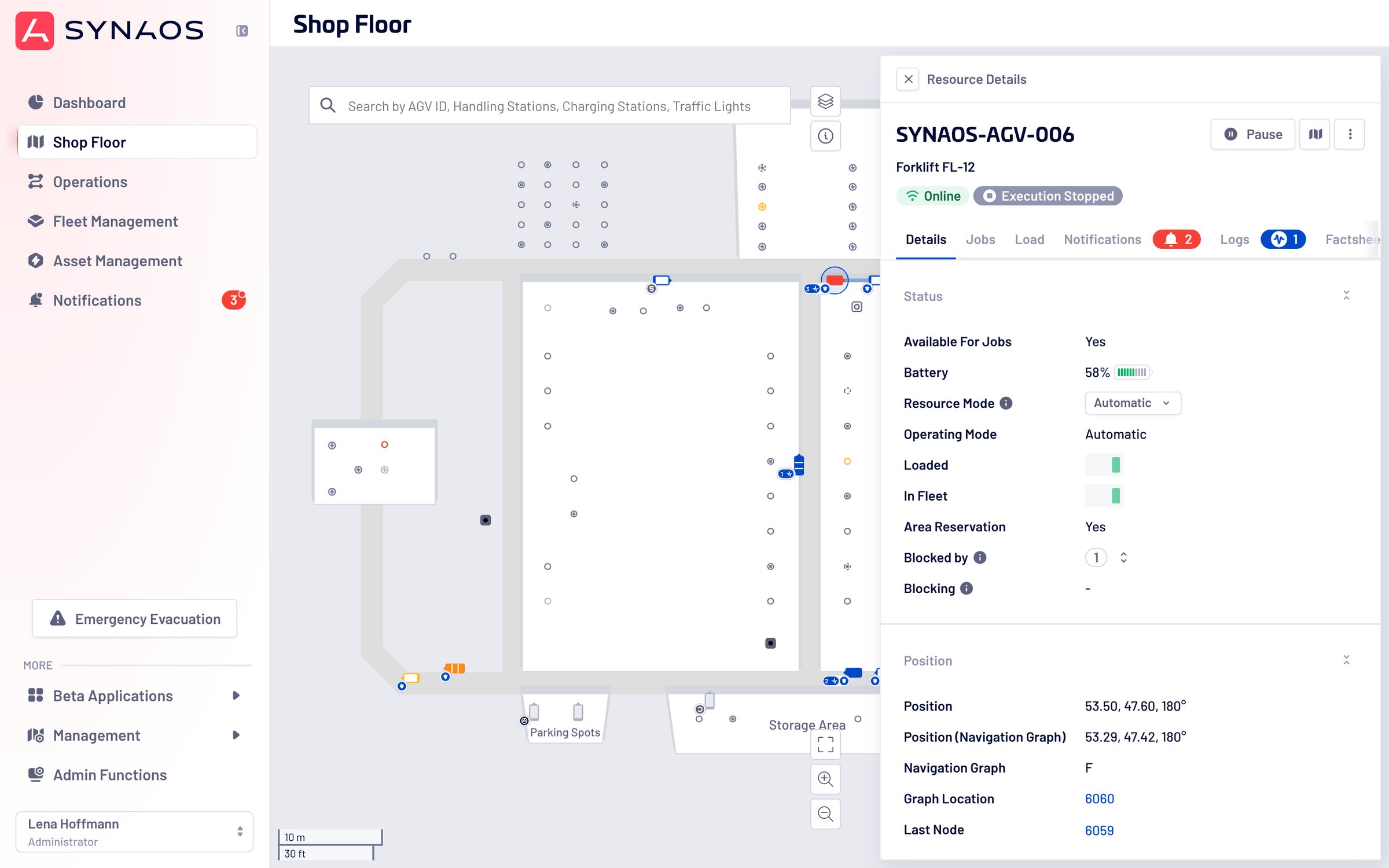
A vehicle selected on the map, with its details in the side panel.
Resize it, close it, and on a small screen it becomes a drawer.
What I’m up to
I started at SYNAOS as one designer among several, and now I’m the only one. AI takes a lot of the heavy lifting off my plate, so I want to put that time into the things that always came last: better documentation, a more mature design system, more of the SYNAOS brand in the product, and consistency everywhere. I also want to grow as a researcher, keep experimenting and have fun doing something useful. The goal stays the same: an app people understand and trust.